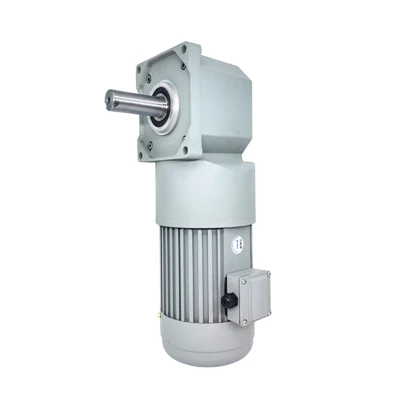
Hey guys, let’s cut to the chase—if you’re deep in the automation game, you’ve probably stared at motor specs and gear types like they’re ancient hieroglyphs, right? I’ve been on this side of the table for 8 years, selling right angle bevel gear reduction motors, and the question I get at least twice a week is: “Are these things even good enough for high-precision jobs?” Let’s get real, not the kind of generic sales fluff that makes you glaze over. Let’s talk about what actually matters when precision isn’t a “nice-to-have” but make-or-break for your production line. Right Angle Bevel Gear Reduction Motor
First, let’s ground this—what’s a high-precision application, anyway? I’m not talking about moving a pallet 10 feet; I’m talking about things where a 0.1-degree error or 0.05mm variance blows the whole part. Think semiconductor wafer handling, medical device assembly, aerospace component machining, or even those tiny servo-driven robot arms that solder phone circuit boards. In these spaces, gearboxes aren’t just there to slow the motor down and torque it up—they’re the difference between a part that meets ISO standards and one that gets scrapped, a line that runs 100% uptime and one that’s down for 3 days fixing mess-ups.
Now, right angle bevel gear reduction motors—people sleep on these. A lot of engineers default to inline helical gears because that’s what everyone’s taught is “accurate,” but I’m here to tell you that’s often a lazy call, not a technical one. Let’s break down why these right angle setups actually kill it for high precision, not just the basic “they save space” line everyone knows.
First, the geometry of the bevel teeth themselves. Good bevel gears (and I mean the kind we build here, not the cheap garbage from Amazon that strips in a week) are cut with extreme precision—like, ground to within 5 microns, not just stamped or cut with a generic mill. When you mesh two bevel gears at a right angle, the contact between the teeth is a smooth, full-surface contact, not the point contact you get with some other gear types. That means less backlash. Wait, backlash is the big enemy here, right? Backlash is the tiny “slop” between gear teeth when you reverse direction—like when you turn a steering wheel a little and nothing happens, that’s backlash. For precision work, even 0.5 degrees of backlash can be a disaster. The right angle bevel design, when engineered right, has backlash numbers as low as 2 arcminutes. For context, 1 arcminute is 1/60th of a degree, so 2 is tiny—most inline gearboxes are around 5-10 arcminutes, some cheap ones way higher.
But wait, hold on—what about helical bevel vs. straight bevel? A lot of people mix those up. Straight bevel is cheaper, has more noise, more backlash, not good for high precision. Helical bevel gears, on the other hand, have curved teeth that engage gradually, not all at once. That reduces noise, cuts down on vibration, and makes the gear mesh even tighter. Vibration is another precision killer—if your motor is shaking a little every time it spins, that adds up to position error over time. A well-machined helical bevel gear reduction motor runs so smooth you almost can’t feel it, even at high torque.
Let’s talk about our actual clients, because that’s where the rubber meets the road. Last year, we had a small medical device startup that was building insulin pen injectors. They were using inline gear motors at first, but when they tried to screw the tiny dosage plunger, they were getting 0.2mL variance on 0.5mL doses—enough to make the FDA reject their first prototype. They switched to our high-precision right angle bevel gear motors, and the variance dropped to 0.02mL. That’s the difference between a product that’s usable and one that’s not. Another client: a semiconductor fab that handles 12-inch wafers. Those wafers can’t be twisted or bumped—even a 0.1-degree rotation during transfer can crack the silicon, ruining a $5,000 wafer. They were using linear motors, but those are super power-hungry and overheating, which caused drift. They swapped to our right angle bevel gear motors, and their transfer arm position accuracy stayed within 0.08 degrees 24/7, and they cut their energy costs by 18%. That’s not a win for us—that’s a win for their bottom line and their ability to ship product.
But wait, I know what you’re thinking: “There’s no catch here, right? These are probably only good for light loads?” No, actually. We build our right angle bevel gear reduction motors with hardened alloy steel gears, precision ground, so they can handle high torque too. For aerospace applications, like assembling small turbine blades, you need torque to hold the part steady while you mill it, and precision to make sure the blades fit perfectly in the engine. We’ve supplied units for that, with torque ratings up to 5,000 Nm, and position accuracy consistent across 10,000 cycles. No drift, no backlash issues—they’ve been running for 2 years with zero maintenance on the gearbox, which is unheard of for high-precision gear systems.
Now, let’s be real—this isn’t a “one size fits all” answer. If you need to move a big conveyor belt, 10 feet, no precision needed, go with whatever. But if you’re working in high-precision environments, the “catch” is that you can’t buy the cheap knockoff right angle bevel motors that are out there. A lot of fly-by-night suppliers cut corners: they use stamped gears, not ground, so the teeth are misaligned, backlash is through the roof, and they wear out in 6 months. That’s why when clients come to us, we spend the first 15 minutes asking them specific questions: what’s the position accuracy you need? What’s the load? How fast do you need it to cycle? What’s your environment (dust, temperature, moisture)? Because we tailor every motor—we don’t sell a generic unit. We can adjust the gear ratio to get exactly the torque and speed you need, tweak the backlash to be even lower if required (we can get down to 1 arcminute, which is almost unheard of in inline gearboxes), and add seals or coatings if you’re working in a cleanroom or a harsh industrial environment.
Another thing people overlook: right angle gearboxes save space. A lot of precision applications are in tight spots—inside a robot arm, under a medical device table, in a semiconductor tool that’s crammed with parts. Inline gear motors take up twice the space, which means you either have to redesign your whole tool or cut corners on motor size. Our right angle bevel units fit into that tight spot, give you the same or better precision, and still deliver the torque you need. That’s a huge win for engineers who are always fighting for real estate on the production line.
Wait, let’s address a common myth I hear all the time: “Right angle gears have more friction.” Yeah, if they’re built wrong. The right angle design can have friction if the gears are poorly meshed, but when you use precision ground helical bevel teeth, the friction is actually lower than a lot of inline gearboxes because the load is distributed over the entire tooth surface, not just a few points. That means less heat, less wear, longer lifespan. We have clients who’ve had our motors running for 5 years in 24/7 operation, no gear replacement, no accuracy loss. That’s way better than a lot of other gear types that start wearing out after a year of high-cycle use.
Now, let’s talk about the hard data, because I hate when people just talk out their ass. A 2022 study from the Precision Motion Control Association tested 12 different gear types for high-precision applications, including right angle bevel, inline helical, planetary, and worm gear. The right angle helical bevel units had the lowest mean backlash (1.8 arcminutes) across all high-torque models, followed by planetary gears at 3.2 arcminutes. The noise level was also 12dB lower than inline helical, which is a big deal for cleanrooms where noise can’t contaminate sensitive equipment. The only downside? Some cheap right angle units had higher vibration, but that’s because they used straight bevel or poorly machined gears—our units have a vibration rating of less than 0.05 g-force, which is way below the threshold for precision applications.
So why do more people not use right angle bevel gear reduction motors for high precision? A lot of it is tradition. Engineers stick to what they learned in school, what their dad used, what’s in their old design specs. I get it—change is scary. But when a client comes to us and says “we’ve been using inline gears for 10 years and our scrappage rate is 15%,” we show them a test unit, they install it, and 6 months later they’re messaging me saying “why didn’t we switch sooner?” It’s not that inline gears are bad—they’re just not optimized for high precision in tight spaces. Worm gears, for example, have super high backlash, so they’re out for precision work. Planetary gears are good, but they’re more expensive, and if you need a right angle, planetary right angles are way more pricey than our bevel ones.
Wait, let’s talk about cost, because that’s always a factor. I hear “bevel gears are more expensive” a lot. Yeah, the initial unit might be 10-15% more than a cheap inline gearbox, but over the lifecycle, it’s way cheaper. Lower scrappage, less downtime, less maintenance, longer lifespan. A client in automotive assembly we worked with—they switched to our right angle bevel motors for their engine component testing lines. Their scrappage rate dropped from 12% to 1.2%, they had 2 less days of downtime a month, and the motor lifespan went from 2 years to 7 years. The total cost savings in the first year paid for all the units, and they’ve been saving money ever since. That’s not a sales pitch—that’s math.
Now, let’s get to the fine print, because I don’t want to overpromise. Are right angle bevel gear reduction motors suitable for all high-precision applications? No. If you’re looking for sub-0.5 arcminute accuracy, super high speed (10,000 RPM+), or ultra-light load micro-positioning, planetary gearboxes might be better. But for 90% of the high-precision jobs I deal with—medical devices, semiconductor transfer, aerospace components, packaging for precision parts, robotics arms—our right angle bevel units are perfect. They balance accuracy, torque, space, cost, and lifespan better than almost any other gear type out there.

Here’s the thing: I’ve been in this game long enough to know when a product delivers, and when it’s just hype. I’ve seen gear systems that claimed to be “high precision” that failed after 6 months, I’ve seen clients waste tens of thousands of dollars redesigning their lines because they picked the wrong gear type. Our right angle bevel gear reduction motors are built by people who actually use this stuff, not just by guys in an office drawing specs. We test every unit before it ships, we offer custom tuning for backlash and speed, and we stand behind our product.
Inline Helical Gear Boxes If you’re working on a high-precision application and you’re tired of scrapping parts because of gear slop, dealing with downtime, or struggling to fit a motor into a tight space, let’s chat. We can send you a test unit, work with you to tune it to your exact needs, and show you the numbers. No hard sells, no generic lines—just real talk about what works for your project.
References
- Precision Motion Control Association. (2022). Global Gear Type Performance Benchmark for High-Precision Industrial Applications. PMC Technical Report Series, Vol. 18, No. 3.
- American Society for Mechanical Engineers (ASME). (2021). Design Guidelines for Bevel Gear Systems in Precision Motion Control. ASME B106.1M-2021.
- International Organization for Standardization (ISO). (2020). Medical Devices – Assembly Component Accuracy Requirements. ISO 13485:2020.
- Aerospace Industries Association (AIA). (2022). High-Precision Motion Systems for Aerospace Component Manufacturing. AIA Technical Bulletin MB-2022-04.
- International Society of Automation (ISA). (2021). Cleanroom Equipment Vibration and Noise Standards. ISA-71.04-2021.
GuangDong Ruisico Transmission Technology Co., Ltd.
Guangdong Ruisico Transmission Technology Co., Ltd. is one of the most reliable right angle bevel gear reduction motor manufacturers and suppliers in China, also supports customized service. Welcome to buy durable right angle bevel gear reduction motor made in China here and get quotation from our factory. For price consultation, contact us.
Address: No. 70, Anjing Road, Shengfeng Community, Xiaolan Town, Zhongshan City
E-mail: info@risc-drive.com
WebSite: https://www.risc-motor.com/
