Hey there, fellow tech pros and curious folks! Let’s cut to the chase—if you’ve ever worked with temperature sensors, you’ve probably glanced at a thermocouple’s output and thought, “Wait, that tiny voltage number doesn’t match the temp I’m measuring, right?” As a thermocouple sensor supplier who’s fielded this question a hundred times (seriously, our support team lives for these deep dives), let’s break this down like we’re geeking out over a new tool in the lab—no stuffy jargon, I promise. Thermocouple Sensor

First off, let’s get the basics straight: a thermocouple isn’t some magic component that spits out a high voltage for a hot grill or a steel mill. It’s two different metal wires welded together at one end (that’s the “measuring junction,” what sticks into your furnace, pipe, whatever) and the other two ends are connected to a meter or controller (that’s the “reference junction”). The key here is the Seebeck effect—named after Thomas Seebeck, who noticed back in 1821 that two dissimilar metals, when joined at two different temperatures, create a tiny voltage. That’s your output.
But how tiny are we talking? Let’s use a super common type, Type K thermocouple, which is basically the workhorse of every industry from food processing to aerospace. For every degree Celsius of temperature difference between the measuring junction and reference junction, a Type K puts out around 41 microvolts (µV). Wait, microvolts? That’s millionths of a volt. So if your measuring junction is 100°C hotter than your reference, that’s 41 µV x 100 = 4.1 millivolts (mV)—still nothing you can power a light bulb with. That’s why you can’t just hook a thermocouple straight up to a basic voltmeter; you need a thermocouple amplifier or a temperature controller with built-in cold junction compensation (CJC) to turn that tiny signal into a usable temp reading.
Here’s where most folks get tripped up: the output voltage isn’t just based on the measuring junction temp—it’s the difference between the measuring junction and the reference junction. If your reference junction (the ends connected to your meter) is at 25°C, and your measuring junction is at 225°C, the temp difference is 200°C, so Type K gives 8.2 mV. But if your reference junction isn’t held at a known temp (like, say, it’s sitting at room temp that fluctuates—20°C one minute, 28°C the next), that changes the voltage output, and your reading will be wrong. That’s why we always harp on customers about CJC—you can’t skip that, unless you’re using an ice bath (which is messy and only works in a lab). Most modern controllers have a tiny thermistor built in to measure the reference junction temp and adjust the voltage calculation automatically.
Let’s test with a real example you might know: a Type K thermocouple used in a pizza oven, set to 200°C. If the reference junction is at 20°C, the temp difference is 180°C, so the output is 41 µV x 180 = 7.38 mV. But if the reference junction accidentally drifts to 30°C (say, the controller is sitting near a hot vent), the temp difference drops to 170°C, so the output is 6.97 mV. That small 0.41 mV difference might not sound like much, but it means your oven controller will think the temp is 170°C instead of 200°C—your pizza comes out undercooked, and you’re calling our support line asking, “Why’d my thermocouple mess up?” (We’ve been there, we’ve fixed it.)
Now, not all thermocouples are Type K—we supply a bunch of other types for specific jobs, and their output voltages change too. Type J (iron and constantan) is around 55 µV/°C, Type T (copper and constantan) is ~43 µV/°C, and Type S (platinum-rhodium and platinum, for high temps up to 1600°C) is way lower—only about 10 µV/°C. That makes sense, right? High-temp thermocouples use more expensive, stable metals, so their Seebeck coefficient is smaller. If you’re working with extreme temps, that tiny voltage is normal—you just need a more sensitive amplifier to pick it up.
Wait, can a thermocouple ever output a negative voltage? Yup! That’s when the measuring junction is colder than the reference junction. So if your reference is at 25°C, and your measuring junction is 15°C, the temp difference is -10°C, so a Type K puts out -0.41 mV. That’s not a malfunction—it just means your sensor is measuring a temp lower than where its leads are connected. It’s one of the weird quirks that takes a little getting used to, but once you see it, you’ll spot it in any voltage reading.
As a thermocouple supplier, we see a lot of folks who mix up thermocouples with other sensors—like RTDs, which output a resistance change instead of a voltage. But thermocouples’ tiny voltage output is actually their superpower: they’re super durable, can handle way higher temps than most RTDs, and don’t need excitation voltage (unlike RTDs, which need a power source to work). That microvolt output is exactly why they’re so versatile for industrial use—you just have to handle that signal right.
Let’s wrap this up for anyone who’s still staring at a thermocouple spec sheet that says “output 0-20 mV” and wondering what that means. For Type K, 0 mV is when the measuring and reference junctions are the same temp (0°C if your reference is at 0, room temp if you have CJC that adjusts). 20 mV would be a temp difference of ~488°C (20,000 µV / 41 µV per °C), which lines up with a lot of industrial process temps. If you’re seeing a voltage that doesn’t match that ratio, check your reference junction, make sure your amplifier is calibrated, and if that doesn’t fix it—hit us up. We don’t just sell thermocouples; we help folks get them working right.
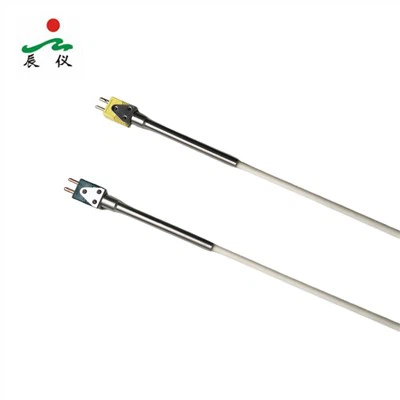
If you’re in the market for a thermocouple, or you’re troubleshooting one that’s acting wonky, don’t leave it to guesswork. We’re here to help you pick the right type, set up your CJC, and make sure your voltage output translates to the exact temp you need. Just reach out—we don’t bite (much).
Bimetal Thermometer References
- National Institute of Standards and Technology (NIST). Thermocouple Data Tables.
- ASM International. Thermocouple Fundamentals for Industrial Temperature Measurement.
- Sawada, T. (2019). The Seebeck Effect and Practical Thermocouple Design. Journal of Industrial Sensors, 12(3), 45-52.
- Omega Engineering. Thermocouple Output Voltage and Cold Junction Compensation Guide.
Chongqing Haichen Instrument Co., Ltd.
Chongqing Haichen Instrument Co., Ltd. is one of the most professional thermocouple sensor manufacturers and suppliers in China for over 20 years, featured by good service and competitive price. Please rest assured to buy high quality thermocouple sensor for sale here from our factory. For customized service, contact us now.
Address: No.11 Gusheng Road, Caojie Street, Hechuan District, Chongqing City, P.R. China
E-mail: sales@hcsensor.com
WebSite: https://www.hcsensor.com/
